The more the words, the less the meaning, and how does that profit anyone? Ecclesiastes 6:11
For nearly fifty years I have aspired to be a consummate communicator. Language has been my instrument, and although I realize that my ability to communicate is a divine gift, I have worked diligently to perfect the craft. Whether in print or in person, I have long labored to become a master of revelatory language, at once clear, creative, and captivating. In my own fashion, I have taken up the ongoing prophetic task: to articulate spiritual realities with spiritual words.
This pursuit has taken me around the world. From Brazil to Bangladesh, from Kenya to Kamchatka, from the U.S. to Ukraine, I have endeavored to translate heavenly truths into human language as accurately and powerfully as the Holy Spirit enabled me. I have declared divine glories to lepers in India and long-boarders in Idaho. I have mapped out invisible paths for saints and seekers in Thailand and Turkey. And through all these years, whether in a stick and stone sanctuary in Africa or a Korean church in New York City, the gift of utterance has never failed me.
Until now. It seems that I’ve run out of words.
My teaching materials, which once flamed with urgency and insight, now seem to me stale and inert, even if they are biblical and true. My learned pontifications feel heavy and lifeless on my tongue. It’s not that the scriptures have lost their sheen; they are as vibrant and pertinent as ever. What has gone dark is my ability (and desire) to amplify the realities that the scriptures signify. As you might imagine, this is somewhat problematic for a guy whose primary vocation is to say things. At the very least, this verbal vacancy seriously hampers the refresh rate of Our Daily Fred.
Whether this condition is temporary or terminal remains to be seen. What is left to me is simply longing. It’s the one thing that doesn’t demand faith of me. For me, longing is an existential, visceral fact. As King David writes, My heart says of you, Seek his face! And, with David, I reply, Your face, Lord, I will seek. The one thing that still functions for me right now is prayer.
And even that I have questioned. What, I’ve asked both God and myself, am I actually doing when I am on my knees? What real fruit comes out of the prayer closet beyond enhancing my own sense of spirituality? What practical balm for the woes of the world? What helpful radiance for the saints in the land? Would the kingdom of God and my fellow man be better served otherwise?
It was during a recent season of such questioning that I happened upon a brief interview with the late Billy Graham. A 92 year-old Graham, frail yet confident, was asked that if he had the opportunity to do it all over again, would he do it differently? “Yes,” he replied in a voice tattered by age. “If I had it to do over again, I’d spend more time in meditation and prayer and just telling the Lord how much I love him and adore him.”
My first title for this piece was Looking Back Ahead of Time. The second was Unregrettable. Maybe the real point of this piece is reflected by a poem of mine, composed quite some time ago:
The Prayer of the Blue-Haired Old Woman
If, my Lord, I am to err, Then let it be Too much in prayer, Too bent on holy reveries, Too long on bent and creaky knees. And should You Catch me unaware, O may it be Heedless in prayer!
There is plenty of God talk out there. The sermons, books, and YouTube videos keep coming. Some of it is even important. Above all, the gospel must be proclaimed aloud to a dying world. Even so, I’d rather not add to the incessant chatter. In fact, at the moment I seem unable to. Please pardon me as I amble quietly through.
Yet behold all the words I have used just to say that I have nothing to say.
“Nearly all homes in coastal farming and fishing villages had an outside toilet, a simple construction rather like a sentry box on a plinth, inside a hole over a chute, with somewhere to place your feet. The chute led directly outside. There was always a bucket of water and a jug for washing your bum after the business was done. From the time piglets were weaned, they were raised to eat human waste. To encourage (compel) them to do that, they were secured by a rope close to the toilet outlet and fed with nothing else except what came down the chute. Once the habit was acquired, the pigs gobbled it up with gusto.”
Despite King David’s moral failings, he is identified as a man after God’s own heart. He was a valiant warrior, a powerful leader, and an elegant composer. His psalms reveal an acquaintance with the divine majesty and a knowledge of the great human predicament. If there is a dominant theme throughout his works, it is the theme of longing. And if there is one lyric that best embodies this longing, it is this one:
One thing I ask from the Lord this only do I seek: that I may dwell in the house of the Lord all the days of my life to gaze on the beauty of the Lord and to seek him in his temple.
What draws David is not the Lord’s power or beneficence. Yes, David is fully aware of God’s mercy and kindness. He knows that God is the strength behind his throne and his shield in times of trouble. But these things are peripheral to David’s deepest desire. What David longs for above all is to behold the beauty of the Lord.
The word that David uses for beauty refers to that which is delightful. David is not speaking of his response to some vision as though delight originates in human experience. He is not seeking to be delighted. For David, beauty is not in the eyes of the beholder. God is beautiful whether David sees it or not. God’s nature and character are delight itself; they do not require affirmation from angel or human to be beautiful. The substance of the Lord’s beauty is his own goodness, not a creature’s response. In the words of the old hymn, God is beautiful even though the eyes of sinful man his glory may not see. The Lord is beautiful because he is beauty itself.
The poem Ode on a Grecian Urn, by John Keats, includes this well-known line: “Beauty is truth, truth beauty.” Some are wary of this pronouncement, warning that beauty can be misleading. After all, does not the scripture say that charm is deceitful, and beauty is vain? Peter tells us that worldly beauty is only outward adornment and not an image of the inner self. But God’s beauty is not worldly; it is the outshining of his being. Paul says that this divine beauty can be seen in what God has made. And if, as Isaiah declares, he is the God of truth, then Keats is absolutely right, even if he didn’t realize why. David would wholeheartedly agree. Beauty is the revelation of truth, and truth is the substance of beauty.
Because there is no truth in Satan, beauty is inaccessible and incomprehensible to him—and he reviles what he does not understand. All he knows is the desire for domination and the compulsion to destroy what he cannot control. Paul’s description of humanity’s fall aptly summarizes the devil’s as well:
Although they knew God, they neither glorified him as God nor gave thanks to him, but their thinking became futile and their foolish hearts were darkened . . . they exchanged the truth about God for a lie, and worshiped and served created things rather than the Creator.
Here is the radical shift common to humans and angels. Transcendent knowledge is replaced by material ignorance; truth and beauty, by deceit and ugliness. This is no mean deterioration; it is a fundamental change of reality. Like Fitzgerald’s Gatsby, our minds once romped like the mind of God, but we are now locked in a spiritless finitude, lost in a mechanical, disenchanted world devoid of beauty.
But ugliness is Satan’s aesthetic, and through pervasive sensory arguments and relentless cultural pressures he is teaching humans to love the ugly and reject the beautiful. His curriculum has been implemented across the cultural landscape, from the arts to fashion to the media. A couple of cases might illustrate his multifaceted strategy.
One prominent example is the systematic distortion of body image. Satan is perverting the ideal of human physical beauty by advocating images of the abnormal and grotesque. Plastic surgery, extreme body modification, obesity, and the like, which have long been considered strange and repulsive, are now forcefully championed as beautiful. To be clear, Satan is not advocating a gracious acceptance of those who look different, nor is he prioritizing the inner beauty of which Peter speaks. The devil is insisting that we embrace physical defect, deformity, and deviance as beautiful; and when the ugly becomes the beautiful, the concept of beauty no longer references truth. Self-admiration and rebellion become the standards of judgment, and the connection between truth and beauty is severed. Wickedness judges itself beautiful.
Closely related to this—perhaps the opposite pole—is the hyper-sexualization of the human body. Although the male body is becoming a target too, this sexualization is overwhelmingly centered on the female form. (It seems that the devil cannot fully counter this elemental human bias.) Even those women who loudly protest being objectified still seek to be objects of desire, presenting themselves as robustly sexual creatures. The crassest example, of course, is pornography, which has risen from the societal dung heap to a place of transgressive status. This sexualization of the female body is one of the effects of the fall. (The biblical record reveals that Satan and his ousted angels were not exempt from the lust for female flesh either.) The devil’s success has been to fetishize the female form— and he’s currently working hard to do the same with the male body. Sexualization of the human body transforms God’s beautiful work into an a garish idol of human sensuality, like a gold ring in a pig’s snout.
These are but two examples of the battle to define beauty which rages across the social and creative spectrums. The devil has relentlessly thrust his warped aesthetic into the fashion industry, the fine arts, literature, music, theater, film, and architecture; and his human allies loudly condemn those who question or refute it. Underlying everything is Satan’s three-fold agenda: to repudiate the work of the creator, to refashion the world in his own image, and to enslave a sinful humanity whose destiny is destruction, whose god is their stomach, and whose glory is their shame.
All that stands between Satan’s uncontested domination is the church’s faithful and courageous witness to the truth and true beauty of the Lord.
“Son of man, pose a riddle, and speak a parable to the house of Israel.” Ezekiel 17:2
Tell all the truth but tell it slant. Emily Dickinson
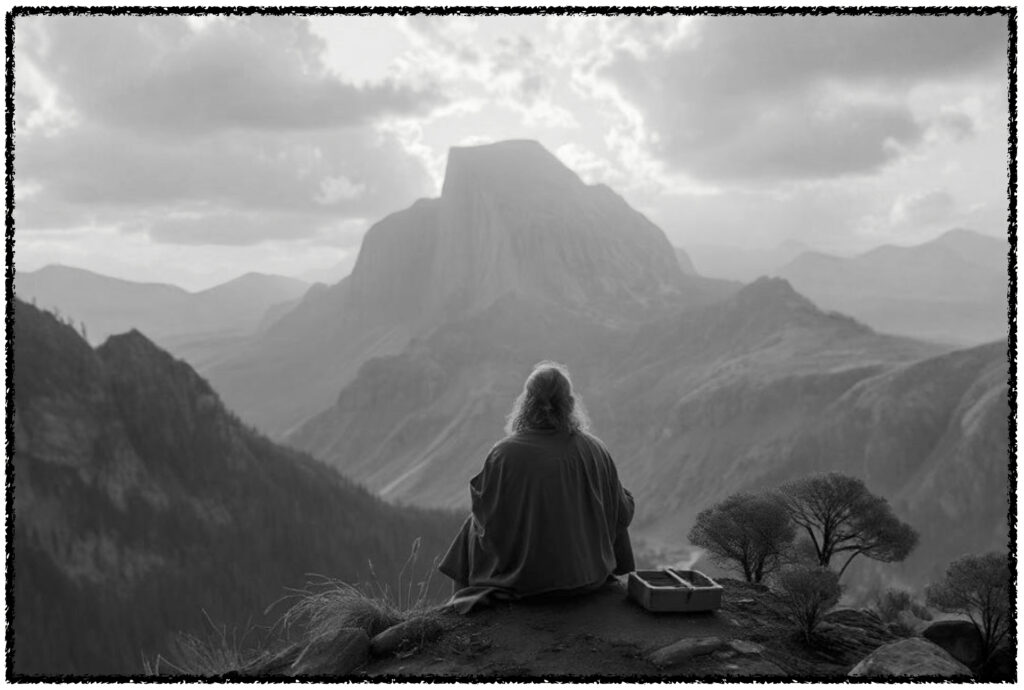
He sat before the mountain, which was not a real mountain, and waited, for such is the way of these things. Then, from the summit, falling into his mind like snow, came a white voice, which was also not a voice, saying:
This mountain is not of my making.
Yes, answered the man.
This voice, too, is an artifice.
I have suspected it. But whose artifice, mine or yours?
The house clammers with those who do not know the difference.
I am often uncertain. How am I to know?
The poet knows that the mountain and the voice are his own. He fashions the rubble of experience into a monument. The true poet will not bow down to his work or insist that others do so. But the prophetic player believes that he stands, privileged and apart, upon Sinai itself and that his words raise an altar which obligates fire from heaven and demands deference on earth.
The prophets of Baal.
God cannot be conjured.
They claim the same Spirit and quote the same book.
They speak visions of their own minds and prophesy from their own spirits. They promise peace to those who follow after their own hearts and thus embolden the rebellious so that they do not turn from their sin. Is not the word of the Lord like fire? Is it not like a hammer that smashes rock?
But their conviction seems honest; their passion, genuine.
Sincerity is not truth. Zeal is not truth.
Are there no true prophets in the house?
Within the din. They do not mistake volume for truth.
How can they be discerned from the others?
As ale is discerned from froth. Froth is agitated, unstable, and mostly air. It floats to the top, and although it too is of ale, it is fizzy and empty of taste. Froth makes for a pretty draught, but it is incidental and fleeting.
There seems much froth in the house.
Not all prophecy—even true prophecy—is created equal.
Why is this so?
The Spirit is extravagant. Judgment has been entrusted to the house.
The prophet is not the enforcer.
The poet may choose his vocation. The prophet does not appoint himself.
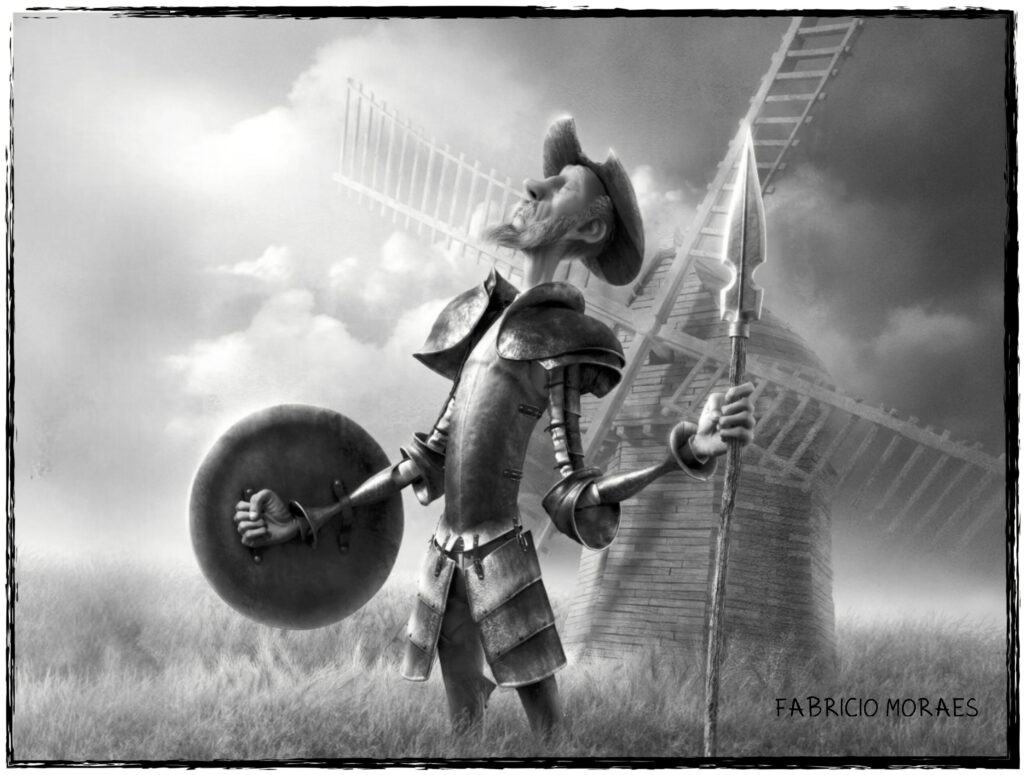
“When life itself seems lunatic, who knows where madness lies? Perhaps to be too practical is madness. To surrender dreams — this may be madness. Too much sanity may be madness — and maddest of all: to see life as it is, and not as it should be!” Cervantes, Don Quixote
If we have lost our minds, it is for God. 2 Corinthians 5:13
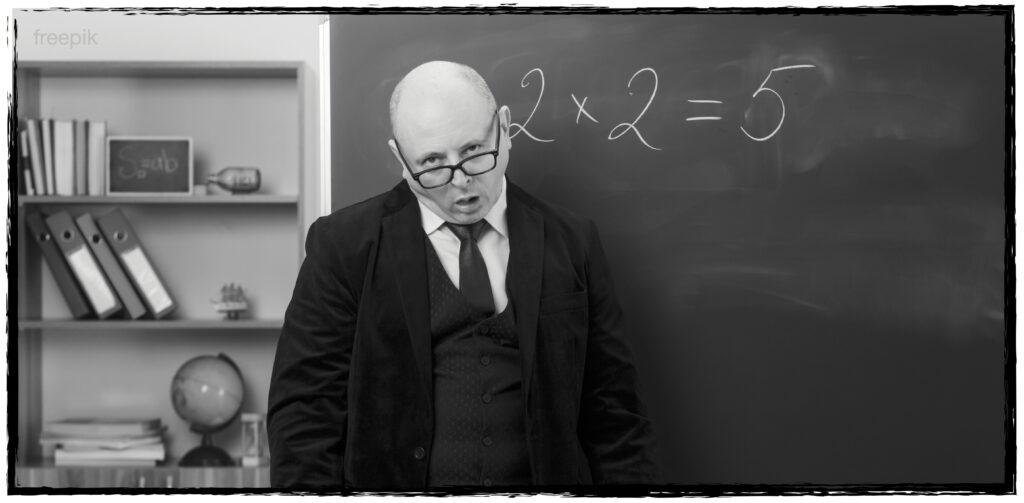
The gospel is crazy talk. We have forgotten that. Subjected to centuries of erudite insistence that the church’s message is fundamentally rational, we have grown desensitized to the outright lunacy of our claims.
When we say that a person is rational, we mean that he possesses normal or sound powers of mind. This is the quality that Jesus restored to the man whom he delivered from the demonic Legion. Both Mark and Luke report that the man regained his right mind; he is once again a rational human being. When we say that some thing is rational, we mean that it aligns with the way things actually are, including with how our minds work; in other words, the thing makes sense.
The list of those defending the essential rationality of the gospel is a Who’s Who of Christian thought: Thomas Aquinas, Jonathan Edwards, John Calvin, G.K. Chesterton, R.C. Sproul, and the 20th century’s reigning champion, C.S. Lewis, to name but a few. In general, and with each allowing for miracles (those inescapable, embarrassing anomalies), they argue that the Christian belief system is founded on rational assertions and is logically coherent. Virtually every sermon I have ever heard presumes the rational intelligibility of the Christian message. We are convinced that the gospel is explainable.
However, in spite of the many intellectual heavyweights who have argued that Christianity is a rational faith, the New Testament writers are not so obliging. The gospel may indeed be the power of God to those who are being saved, but it’s not only the unbeliever who finds the church’s message foolishness. The god-smacked Paul himself admits to the folly of what we preach. As much as we might like it otherwise, the New Testament proclamation is neither rational nor reasonable nor relevant. There’s no way around it; the gospel of Jesus Christ is insanity on a stick.
Rational?
The biggest obstacle to a rational Christianity is Christ himself. If it weren’t for Jesus, X-ianity would parse just fine. But how do you solve a problem like Messiah? The gospel’s central assertion is that in Jesus, as Paul puts it, all the fullness of the Deity lives in bodily form. This poses an insurmountable issue for anybody who hopes to formulate a rational system of belief. Even Jesus can’t seem to get his theology straight. On one hand, he asserts that “God is spirit.” On the other, the risen Jesus shows himself to his disciples and reassures them that “a spirit does not have flesh and bones, as you see I have.” On one hand, John insists that no one has ever seen God. On the other, Jesus declares, “Anyone who has seen me has seen the Father.” This schizoid dance finds its culmination in Paul’s most succinct statement about the nature of Jesus Christ:
He is the image of the invisible God.
It doesn’t take a theological Einstein to note that this statement is pure nonsense. If something has an image, it’s not invisible; if it’s invisible, it doesn’t have an image. How is it possible to build a rational system on top of that? We have certainly tried. But as Oliver Wendell Holmes noted, insanity is often the logic of an accurate mind overtasked.
The wicket is so sticky that the late John Wimber, a professor at Fuller Theological Seminary and influential founder of the Vineyard movement, felt the need to coin a new word—transrational—to classify the gospel’s disregard for reason. But it is Festus, the Roman governor who listened to Paul’s gospel presentation, who tells it like it is. In the middle of Paul’s defense, Festus interrupts him and shouts, “You are out of your mind, Paul! Your great learning is driving you insane!” The governor has a point. There is nothing sensible about the gospel of Jesus Christ. It may be true, but it is decidedly not rational.
Reasonable?
For most, or for most Christians anyway, the absurdity of the gospel’s central claim is only a mild curiosity, a benign theological oddity of little, if any, practical concern. Far more problematic are the gospel’s demands, which Jesus summed up in a single devastating ultimatum:
“Anyone who does not renounce all that he has cannot be my disciple.”
This isn’t a one-off either. Jesus tells the rich young ruler who had come to him seeking eternal life, “One thing you lack. Sell all that you have . . . and come, follow me.” At many times and in many different ways, Jesus insists that those who wish to follow him must give up everything and take up the cross. The Twelve accept this at face value. Peter confesses to Jesus, “We have left everything and followed you.” For the first disciples the gospel of Jesus was an all or nothing proposition.
This is untenable for today’s Western Christians. To renounce all we have as a condition of discipleship reeks of fanaticism. Except for the mythical saint or religious whacko, to give up everything to follow Jesus is not only unreasonable but realistically impossible. No one in his right mind could entertain Christ’s demand literally.
So we don’t. Our preachers and commentators help us finesse away the brute force of Christ’s words and to shape a less literal, more amiable mandate. A sampling:
It’s not a physical giving up but a mental and emotional letting go.
Being a disciple of Jesus Christ requires us to let go of our own desires, interests, and priorities.
This passage speaks to the importance of loyalty and allegiance to Jesus over all other competing loyalties, including family, self-interest, and possessions.
This figurative passage means to let nothing stand between us and Jesus.
An unmitigated Jesus is not reasonable. His gospel is extreme, disruptive, and unworkable in the modern age. Apparently, he hadn’t foreseen that.
Relevant?
One of the hallmarks of the reasonable gospel is the promise of a better life. The sensible church is in the personal enrichment business and offers a Jesus whose main job is to make life better, as is evidenced by the standard issue sinner’s prayer which instructs us to “ask Jesus into our lives.” But according to Jesus and the New Testament writers, we have no life to ask Jesus into; humanity is as dead as a doornail. The kingdom of God is not relevant to the world; it has nothing to do with the kingdom of this world at all. Paul declares:
What do righteousness and wickedness have in common? Or what fellowship can light have with darkness?
The answer is nothing. Absolutely nothing. The gospel does not enhance anything. Jesus did not come to improve the world’s system but to extract people from it. “My kingdom,” Jesus explains,“is not of this world.” C.S. Lewis refutes any balderdash that Christ’s teachings would make the world a better place: Let us not come with any patronizing nonsense about his being a great human teacher. He has not left that open to us. He did not intend to. The gospel of Jesus Christ is not a fix for the world’s problems; it’s the portal to another reality altogether. To market Jesus and his message as relevant is to miss the whole point.
Jesus said, “I praise you, Father, Lord of heaven and earth, because you have hidden these things from the wise and learned, and revealed them to little children.”
Crazy Cats
Groucho Marx famously quipped, I don’t want to belong to any club that will accept me as a member. The church might wish to take heed. The more we attempt to package Christianity as rational, reasonable, and relevant, the harder is the sell. A gospel sanctioned by human reason, propriety, and priority is no gospel at all. It is mere religion. Who wants that?
The Word made flesh defies understanding. The Holy Spirit repudiates logical suppositions. The church’s message is utterly preposterous. John Milton’s epic attempt to justify the ways of God to man was doomed from the start. The gospel cannot be explained, but it saves all who believe.
And we who believe are also inexplicable. We are insanity incarnate, the new images of the invisible God. We are impossible, and yet here we are.
For since in the wisdom of God the world through its wisdom did not know him, God was pleased through the foolishness of what was preached to save those who believe.
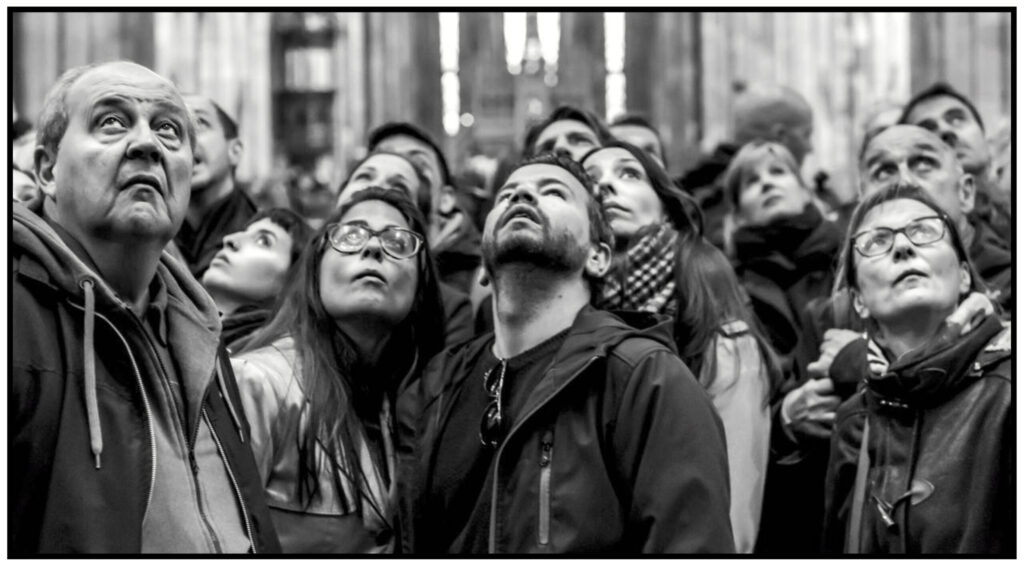
“Why do you stand here looking into the sky? This same Jesus, who has been taken from you into heaven, will come back in the same way you have seen him go into heaven.” Acts 1:11
Somewhere along the line we appear to have misplaced the Second Coming. Relegated to the backwaters of contemporary theology or made dubious by a perpetual parade of pious prognosticators, the return of Christ has faded from our front-and-center Christian proclamations. It has become a mere footnote to the modern gospel, a fuzzy ancillary legend of minimal immediate import. The venerable threefold message of a savior who died, rose, and is returning seems to have dwindled into a binary cross and cope formula: Jesus forgives you, now do your best. The promised second coming is a lovely notion, but it seems to have little, if any, practical value for walking out the Christian life. For the daily grind, church cuisine tends to favor ground beef rather than pie in the sky.
This reflects the modern church’s shift of emphasis from the hereafter to the here and now expressed by a gospel that seems more salve than salvation. And set against today’s urgent physical and social needs, talk of a better someday seems a scant provision for surviving this day.
But the return of Jesus is not a glamorous accessory to his sacrifice and resurrection, nor is it a door prize for those with tickets to the main event or a carrot on a stick for some simpleton saints. Far from it. The second coming of Christ is, in fact, an essential part of the gospel and as necessary to confirm its legitimacy as is the resurrection itself.
First, without the second coming, Christianity is a fundamentally subjective experience that cannot verify universal truth. A person’s experience with Jesus, as real and life changing as that may be, only verifies that he or she has had an experience; it is a true experience but may not point to a greater truth. (Psychiatric wards are filled with authentic experiences that do not align with objective truth.) Granted, signs and wonders—including healing, deliverance, and other miracles—historically attest to the objective truthfulness of the gospel, but those phenomena are exceedingly rare these days. (There’s a good reason for this, but that’s another discussion.) Jesus and the New Testament writers point instead to love as the greatest evidence. To be sure, love is a powerful witness, but as Jesus declares, the believers’ love for each other testifies“that you are my disciples.” What love does not do is prove that Jesus is the son of God and savior of the world. There are, after all, any number of cults and clubs that can boast a robust fraternity, but that doesn’t mean that their charters define truth.
Jesus himself underscores the subjective nature of Christianity. “The coming of the kingdom of God is not something that can be observed, nor will people say, ‘Here it is,’ or ‘There it is,’ because the kingdom of God is within you [or in your midst].” In other words, the reality of the kingdom resides only within those who believe. That the greatest truth would be made known on such a limited scale troubled some of the disciples. “Lord,” asked one. “Why do you intend to show yourself to us and not to the world?” To which Jesus replied, “Those who love me will obey my teaching. My Father will love them, and we will come to them and make our home with them.” Objective proof of the gospel will have to wait until the return of its author when every eye will see him, even those who pierced him. When the Son returns, both faith and unbelief will succumb to objective fact; the kingdom of God will be within and without.
Second, because the kingdom of God is for now a fundamentally subjective experience (no matter its outward expression) until the Lord’s return, the gospel can be falsified. Arguments against the veracity of the gospel are as authoritative as the arguments defending its truthfulness. It’s one subjective experience versus another. This does not imply that there are two sets of facts. Facts are facts. Disputes nearly always arise from differing interpretations of the facts at hand. A good example is the disagreement about what the earth’s archeological data suggests. Both parties observe the same empirical evidence, but they strongly disagree about what that evidence is evidence of. In the same way, the claims and experiences of Christians can be countered by those with different claims and experiences. Muslims have their own holy book and spiritual encounters, as do Hindus and Buddhists. Even atheists can point to authoritative sources and appeal to personal experience—even if it’s the experience of the absence of spiritual experience.
Every honest witness is a reliable witness of his own experience, whatever it is. If a madman is convinced that he’s Napoleon and says so, he’s not lying. We may disagree, but that’s our viewpoint, not his. We can argue with him, but for the madman all evidence irrefutably points to his Napoleonic identity. T.S. Eliot asserted that everything can be shown to be true from some perspective. (Einstein might agree to a degree.) Our madman may entertain delusions, but they are real delusions. Until the return of Christ, it’s testimony versus testimony.
Peter warns of those who doubt that the Second Coming will happen at all: You must understand that in the last days scoffers will come . . .They will say, “Where is this ‘coming’ he promised? Ever since our ancestors died, everything goes on as it has since the beginning of creation.” Their perspective, Peter maintains, is based on willful ignorance, but Paul insist that this is the case for everybody. No matter; until Jesus returns, everything is debatable.
Finally, not only is the Second Coming the last, necessary confirmation of the gospel and the vindication of the church, it is also—and maybe mostly—a rescue operation. Without the return of Christ, the church would be destroyed. Talk of a triumphant church often omits the sobering reality that the victory will come after the defeat of the saints, a defeat so profound that only the return of the King will deliver them. In his Revelation, John speaks of a great Dragon who enthrones a terrifying beast and empowers him in order to subdue all who are in the world:
The beast was given a mouth to utter proud words and blasphemies and to exercise its authority for forty-two months. It opened its mouth to blaspheme God, and to slander his name and his dwelling place and those who live in heaven. It was given power to wage war against God’s holy people and to conquer them.
In the end, Jesus will come again for a besieged people who are faithfully awaiting deliverance. No amount of spiritual bravado will save them from the enemy. In the face of the full fury of hell, all the saints can do is remain steadfast. “You will be hated by everyone because of me,” Jesus warned his disciples, “but the one who stands firm to the end will be saved.” The church’s triumph is the return of the King.
The grand finale of the gospel is not the resurrection of Jesus; it is the promised Parousia. We shall not be fully saved until he comes again for us. He will rescue us from a world destined for destruction and gather us to himself forever. This is the great hope and should be unapologetically proclaimed alongside the message of the Cross and Resurrection. The second coming of Christ is a hope beyond cope, a glorious impetus to righteousness, perseverance, and zeal—and we need to hear more of it.
The hour has already come for you to wake up from your slumber, because our salvation is nearer now than when we first believed.
Jesus answered, “Do you say this of your own accord, or did others say it to you about me?” John 18:34
Recently, I had coffee with a local leader of a prominent Christian ministry. The meeting was prompted by a strange request—that I teach him how to pray. When he first brought it up via email a few weeks earlier, I was caught off guard. For one thing, the ministry that he is a part of has long been a prayer-forward organization, and I know that he himself considers prayer a top priority. That this experienced, committed leader would admit naiveté about something so fundamental to the Christian life seemed not only humble but extraordinary. Even more startling was that he considered me somebody who might help him learn. Most startling of all, he confided that I was the only person among his cohorts who stood out as someone who might be able to. I was honored to be considered such a resource but a bit unsettled by it too.
We met at a bustling coffee shop in town. After exchanging pleasantries, the conversation swerved to the matter at hand. He shared the significant ministry challenges he was facing and his determination to do what must be done in order to restore vision and purpose to his missional community. To my mind, that alone would warrant serious prayer. But then his tone abruptly shifted. With sudden and surprising passion (it was a public place, after all) he confessed a consuming desire to know God. His voice strained with emotion. But what really struck me were his eyes; they burned with a desperate and fierce hunger. His intensity staggered me. This earnest man, who had committed years of his life to raise up serious followers of Jesus, was himself famished for God. I cannot remember when I last encountered such furious spiritual longing in a Christian.
In fact, I am baffled by how satisfied most Christians seem to be. They are comfortably saved and generally content in their relationship with the Lord. If some do acknowledge a lack in their spiritual lives, it’s a minor one that they seem to tolerate well enough. Insatiable hunger for God is to them both alien and unintelligible. For most Christians, prepackaged affirmations and quippy lifestyle tips seem good enough.
This preference for second-hand revelation is nothing new. God has always proven a bit much for well-balanced types. Israel’s reaction at Mount Sinai to a turbulent visitation is a case in point and serves as the template for two thousand years of curated Christianity:
Now when all the people saw the thunder and the flashes of lightning and the sound of the trumpet and the mountain smoking, the people were afraid and trembled, and they stood far off and said to Moses, “You speak to us, and we will listen; but do not let God speak to us, lest we die.”
By the time Jesus arrives on the scene, it seems that God has recognized the futility of offering pearls to pork. Revelation is no longer disbursed by blunt instrument but is reserved for those who actually pursue it. Jesus informs his motley crew, “To you it has been given to know the secrets of the kingdom of God, but for others they are in parables, so that seeing they may not see, and hearing they may not understand.” Spiritual insight is awarded to the earnest seeker. “You will seek me and find me,” says the Lord through Jeremiah, “when you seek me with all your heart.” No amount of preaching and teaching can bring the complacent to the mountaintop. For the terminally satisfied the word of God is one word more than they want.
And so the Christian experience, like so much else in our culture, has become a matter of information rather than incarnation, explanation rather than impartation, validation rather than visitation. Energetic singing and sermons are surrogates for presence. (Has anyone noticed?) We are earnest but maintain a safe distance from the fire on the mountain. We gather to pay our respects, not to die.
I wonder, now, for whom I am writing this. The satisfied among my brethren will read this, if they read it at all, as a mere curiosity. For them there will be neither illumination nor motivation in it. But for the hungry—the famished—perhaps it will be a reassurance that they are not alone. Others among your spiritual kinsmen also long for the living God. Find them. And remember this, my starving friends: “The kingdom of heaven is like treasure hidden in a field.”
Get back, get back, get back to where you once belonged. The Beatles
One of the late comedian George Carlin’s most famous routines, A Place to Put My Stuff, playfully exposes our tendency to accumulate things. It’s a brilliant set piece that showcases Carlin’s razor-sharp observation and his masterful use of language. According to Carlin, we never seem to have enough space to store our stuff. (To see a sanctified excerpt of his routine, click here. For an unbleeped version click here.) Stuff R Us.
Nowhere is Carlin’s comedic insight more apparent than with the self-storage business. Over the past 40 years, the self-storage industry has been one of the fastest growing sectors of the U.S. commercial real estate industry. There are approximately 52,300 storage facilities in the U.S. To put that into perspective, there are as many storage facilities as there are American locations of Starbucks, McDonald’s, Dunkin’ Donuts, Pizza Hut and Wendy’s combined. Self-storage facilities contain an average of 546 units each, and even though that amounts to one unit for every 12 Americans, the industry boasts a 96.5 percent average occupancy rate. Most surprising—or maybe not—is that over three-quarters of self-storage tenants are homeowners, and 65 percent of all self-storage renters have a garage. Apparently, the bigger the place, the smaller the space.
Every so often I discover that I, too, am overrun by clutter. I don’t mean by material things, though my own garage might suggest otherwise. What I mean is that I find myself beset by invisible flotsam that has slowly accumulated around my soul. It’s hard to characterize these stealthy accretions; they are as hazy and ethereal as smoke. Attempting an inventory is futile. Besides, it’s only taken altogether that these blurry barnacles register at all.
For me, the tell-tale sign of soul clutter is an inner fuzziness. When I’m running lean and mean, I blaze with clarity, as though my spirit surges with an astringent hit of pure being. I’m a clear channel for high voltage reality. When I’m cluttered, I feel like a sluggish, debris-clogged backwater.
Of course, attempting a detritus dump in order to recover some vaguely imagined authentic self is about as productive as emptying the trash on the Titanic; and if it came down to it, I’d rather bunk on a crowded cargo ship that at least gets me where I want getting to. The ark may not be fancy, but it floats. Decluttering the soul is not metaphysical tidying up.
The only remedy that I’ve found for soul clutter is a wholesale reset. There’s no going through the pile to see what’s worth keeping; all of it’s the problem. And since attempting to off-load intangibles is a fruitless endeavor anyway, the one solution is to abandon ship and start at the very beginning—which, I’ve heard, is a very good place to start.
And this is where the impractical demand of the gospel may actually be [gasp] a practical godsend. Jesus sets down impossible terms for would-be disciples: “Any of you who does not give up everything he has cannot be my disciple.” Seriously? Give up everything? How in hell (or heaven or earth) is a chronic hoarder supposed to pull that off? What does give up everything even mean? But there it is like the thorn of a rose, inescapable and nonnegotiable. First practical insight: In spite of all the precious crap you’ve amassed, in both house and heart, the reality is that you’ve got nothing to lose. You’re damned if you do and damned if you don’t. (I said practical not agreeable.) You’re bankrupt; you might as well declare it.
But although most of us know—as do an unfiltered Carlin and Apostle Paul—that our stuff is shit [σκύβαλον, Philippians 3:8] we’re still loathe to part with it. It may be shit, but it’s essential shit, and we want to hang onto it. And so we revise the terms of endearment so that we can have our Christ and keep shit too.
If it were merely a matter of divine edict, we might be able to get away with it by pleading our humanity and playing the grace card. But we’re not dealing with an aloof divinity who lays down the law from on high. We’re dealing with a carpenter who had the audacity to actually practice what he preached. This Jesus, claims Paul, who was in very nature God, did not consider equality with God something to be grasped, but emptied himself. This is extraordinary and terrifying, so terrifying, in fact, that many commentators simply cannot accept Paul’s claim at face value. His Greek, however, is crystal clear: To take on the nature of humanity, Jesus completely drained himself of whatever it meant for him to be in the form of God. Deal with it. Second practical insight: Decluttering the soul isn’t about off-loading the stuff; it’s about off-loading the self—and the self cannot off-load itself.
There’s only one place you can go for that, only one place where you can lay down both your soul and your inability to lay it down. I’d tell you, but you’re not desperate enough. Besides, you already know where. But you like the clutter—or if not exactly like it, you definitely want it more than you don’t. I know this. So do you. The only thing empty is your protest.
So what are you forfeiting? You have no idea. You literally have no idea. Beyond this point everything is for you only words, just more stuff to add to the pile. (Let’s call this pile the earnest Christian pile.) This is why you are what you are. I know this too.
And this is why we are what we are instead of what we could be.
Could I, if offered glistening wings, break free, or would I clutch, afraid, the turning leaf, this hull I’ve made, this chrysalis crafted from my things?
Newly Published
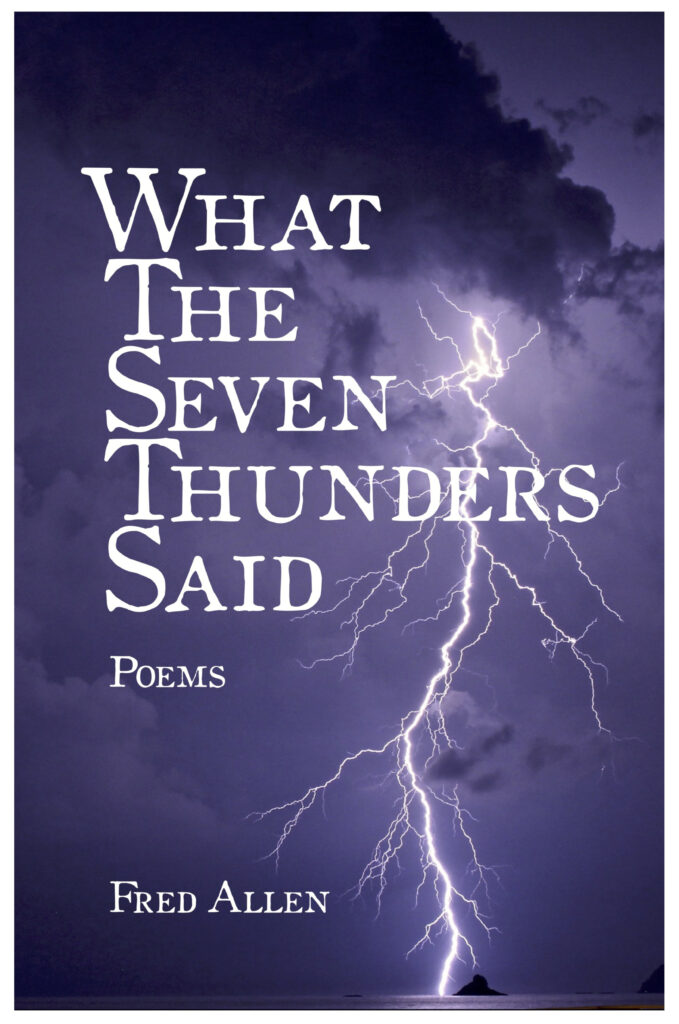
In John’s astonishing and enigmatic Revelation, he overhears the voices of the mysterious Seven Thunders, but he is commanded to seal up what they say and not to write it down. Allen too has heard their voices, and in a series of oracles, notably concise and immediate, he unseals their urgent testimonies. This collection showcases the unique power of poetry to embody elusive spiritual realities in all their Delphic glory.
In the first act get your principal character up a tree; in the second act, throw stones at him. Anonymous
When I first paused Our Daily Fred, I had no idea that the intermission would be months long. All I knew at the time was that the first act was over and that the second act—if there were one—would introduce complications. What those complications might be, I could not say, but I did know that the second act could not simply be more of the first. A plot that does not thicken makes for a thin soup.
And then something unexpectedly appeared early on in the break. A medical examination for a minor issue led to the discovery of a nodule on my thyroid. The radiologist noted certain features that warranted a biopsy, and so one was scheduled for a couple of weeks later. The results of the biopsy would come in a week or so after that. Those weeks were spiritually intense for me. I wasn’t afraid of dying; as the 17th century poet and cleric John Donne wrote, one short sleep past, we wake eternally. More than once during those days I pondered the sweet relief of laying down the burdens of this broken world. For those in Christ, death means untroubled rest until the day of resurrection.
Even so, the real possibility that my lifespan was to be far shorter than I had projected was problematic. I didn’t fear death, but I didn’t welcome it either. In fact, an early exit didn’t fit into my plans at all. I still had things to do. More importantly, I was convinced that there were people who needed me to stick around—and I don’t mean in an emotional attachment kind of way. It was bigger than that. For over a decade I have taken seriously the call to prayer and its power to help others. I have been committed to “stand in the gap” for those who needed an extra shot of grace. Dead men don’t pray. I needed to remain above ground so that, like Jesus, I might live to intercede for them. For some of them, at least, my secret labors were vital.
But the uncertainty about my long-term prospects also served to focus my attention on the phenomenon of death itself. Of course, like nearly everyone, I had long acknowledged the academic fact of death, but now I faced the hard proximity of it. Theory had become reality; the hypothetical had become nodule. I realized that, ultimately, neither fervent faith nor earnest prayer could revoke the irrevocable judgment: it is appointed for man to die once. Like it or not, I had to play the cards I’d been dealt.
I wondered if this was the complication that would spark the second act. Would Our Daily Fred become one of those pathos-drenched accounts that documents the author’s “courageous battle” to its poignant, inescapable end? Would I want to add my voice to that woeful genre? Would I want to spend my last energies crafting a self-portrait of admirable nobility in the face of certain defeat? Or would I decline to strut and fret my last hours upon the stage, pull the plug on Our Daily Fred, then privately wend my way to dusty death? How Shakespearian.
Beyond the potential drama of it all, dying responsibly takes planning. My rude awakening prompted me to put my affairs in order, which, I confess, I should have done 25 years ago when I started gallivanting around the world. I revised my will and completed an advance directive which were witnessed and notarized. I compiled an extensive list of important contacts, contracts, accounts, passwords, and other vital data for easy reference. I also jotted some thoughts about a memorial (no marching band) and my preferences concerning those blunt but necessary end of life arrangements. To have all these things finally written down and safely filed was a major relief.
Yet I was in no way resigned to an imminent departure. As I waited for the results of the biopsy, I doubled down in prayer and listened carefully to what God might have to say. On one hand, I was encouraged by many reassurances that God heard my cries and would deliver me. On the other, there were as many reminders that I needed to trust him no matter what hit the fan. I found myself see-sawing between “Let this cup pass from me” and “Not my will but yours.” In spite of my confidence in the mercies of the Lord, a cloud hung over those days. To be sure, there were days of quiet joy and peace, but there were many that drained my faith to the dregs.
And then the test results were posted to my online chart. I hesitated. Should I end the uncertainty by checking the results myself or wait for my doctor to follow up which could take a few more days? It so happened that an acquaintance, who was being treated for a heart condition and was unaware of my situation, mentioned that he had recently looked at his test results a day before he was scheduled to meet with his doctor. The results seemed terrible. He couldn’t sleep all that night and came to his appointment deeply dispirited. His doctor looked over the results and told him that everything looked good. My friend was surprised and answered that what he had seen didn’t seem very good at all. His doctor frowned and barked, “Don’t look at that stuff!”
And so I decided to wait until my own physician delivered the verdict himself. But I didn’t simply wait it out. Instead, I returned to my prayer closet, knowing that even now nothing was impossible for God. I cried out for deliverance even as I steeled myself for the worst. Two days later I received an early morning notification that my doctor had left me a message. With a deep breath I opened the message and read: I have reviewed this test result. Great news! The thyroid biopsy shows benign thyroid tissue.
“If that condition of mind and soul, which we call inspiration, lasted long without intermission, no artist could survive it. The strings would break and the instrument be shattered into fragments.” Pyotr Ilyich Tchaikovsky